A remarkable timeline
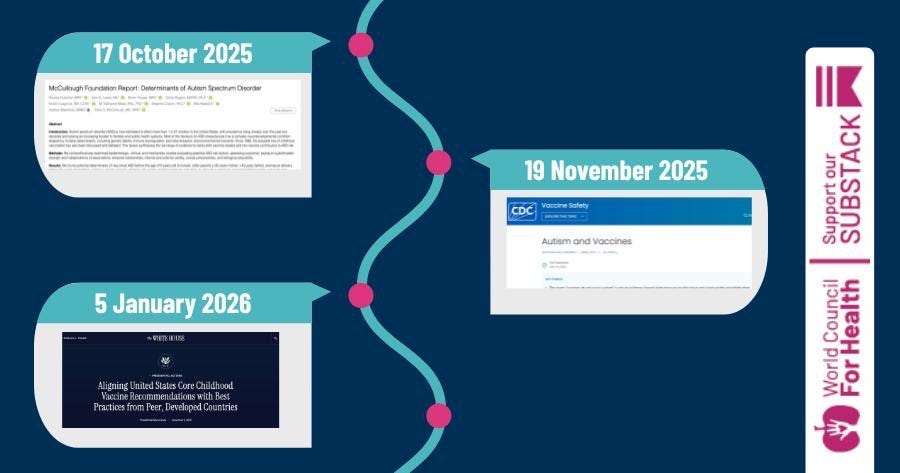
Readers of the World Council for Health Substack may be aware of a landmark report published by the McCullough Foundation in Autumn 2025. In an analysis of 136 studies, the authors concluded that 79% of these pointed to a link between vaccine components and neuroimmune dysfunction – including Autism Spectrum Disorder.
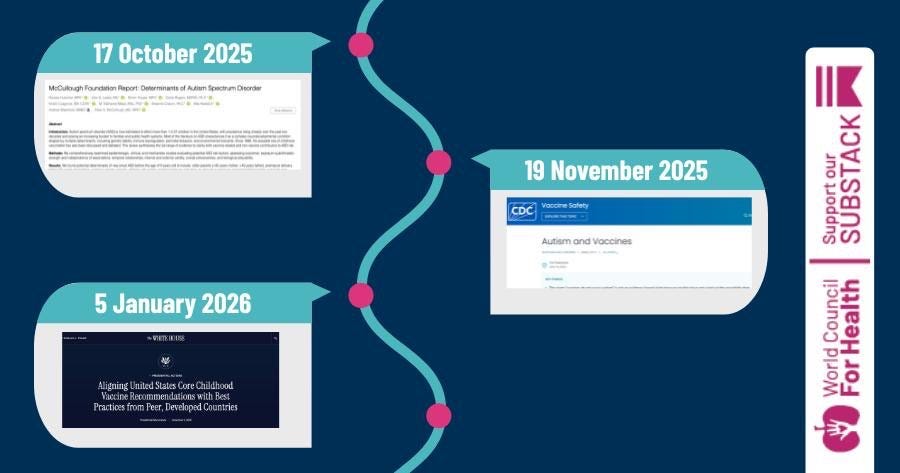
The sequence of events demonstrates that in the US at least, meaningful change is occurring at the highest levels of policy-making:
-
27 Oct 2025: McCullough Foundation’s Report was sent to the CDC
-
19 Nov 2025: CDC (quietly and delicately) changed its stance on the vaccine/autism issue
-
5 Jan 2026: CDC announced that the US childhood vaccine schedule would be significantly reduced
Subscribe now
Snapshot of events
1. McCullough Foundation report
The Foundation’s official Press Release, on 27 October 2025, states the following:
‘The report concludes that autism arises from the intersection of genetic, environmental, and iatrogenic factors— but notably combination routine childhood vaccination early in life constitutes the most significant modifiable risk factor, supported by convergent clinical, mechanistic, and epidemiologic evidence.’
It can be downloaded here:
Download
Download
In addition, the key findings are described in this short interview from early November with Peter McCullough and Nic Hulscher, who led the study.
2. CDC’s change of stance
As pointed out by investigative journalist Maryanne Demasi in her succinct assessment of the rewritten guidance:
“This is a change that could reshape one of the most politically charged and emotionally fraught debates in modern medicine.
In a website update published on 19 November 2025, the agency now states that the long-standing claim “vaccines do not cause autism” is “not an evidence-based claim” because scientific studies “have not ruled out the possibility that infant vaccines cause autism.”
The page also acknowledges that “studies supporting a link have been ignored by health authorities.”
It’s difficult to overstate the significance of these statements. For nearly two decades, they would have been unthinkable for a federal public health agency.”
3. Trimming of US childhood vaccine schedule
On 5th December 2025, a Presidential memorandum requested that the US childhood vaccine schedule be compared with the schedules of other, similarly developed countries.
On 5th January 2026, the findings and subsequent policy changes were announced in a press release by the US Department of Health and Human Services. It noted:
“The assessment reviewed 20 peer, developed nations and found that the U.S. is a global outlier among developed nations in both the number of diseases addressed in its routine childhood vaccination schedule and the total number of recommended doses (…) For example, in 2024, the U.S. recommended more childhood vaccines than any peer nation, and more than twice as many doses as some European nations. At the lower end is Denmark, which immunizes children against 10 diseases compared to a total number of 18 diseases for which protection was provided in 2024 in the U.S.”
To align with international norms, therefore, the CDC significantly narrowed the core childhood vaccine schedule. The vaccines were then categorised into threetiers: (i) recommended for all children; (ii) recommended for certain high-risk groups; (iii) recommended based on shared clinical decision-making.
“After an exhaustive review of the evidence, we are aligning the U.S. childhood vaccine schedule with international consensus while strengthening transparency and informed consent. This decision protects children, respects families, and rebuilds trust in public health.”
–Robert F. Kennedy Jr., HHS Secretary
It is important to note that all the vaccines remain available and covered by insurance. Furthermore, HHS’s accompanying fact sheet states that “the CDC will continue to recommend that all children are immunized against 10 diseases for which there is international consensus, as well as varicella (chickenpox).”
The changes do not, therefore, indicate a wholesale rejection of vaccines. Rather, they emphasise an individualised approach instead of a one-size-fits-all.
Share World Council for Health
Not far enough… or too far?
Some might argue that in light of increasing evidence surrounding vaccine harms, this policy change does not go far enough. But what must be recognised is that this is a massively important step – especially when considering the vehement pushback against anything that is considered “anti-vax”.
For example, take this article by bioethicist Arthur Caplan in MedPage Today (published on 6 Jan 2026). In his condemnation of the CDC’s new approach, the language is noticeably absolutist: “outrage from vaccine experts… outrage that is absolutely justified… this dangerousshift in guidance… The existing data unquestionably support the disease-preventing and life-saving efficacy of the current childhood schedule… a despicable moral choice… inevitably lead to greater morbidity and mortality… To some, illness and deaths are the price of freedom.”
This is followed by an outright rejection of individual agency in vaccine matters, framing trust in authority as a moral imperative which must be upheld:
“But, in the name of ethics and public health, choices that lead to preventable childhood deaths ought to be curbed. And a choice is not really a choice if parents are swamped with vaccine disinformation.”
Whether this kind of rhetoric is self-defeating is another matter. But it does serve to highlight how individuals and institutions who are working towards positive transformation are operating within a broader public health environment: one in which hostile attitudes towards even moderate, evidence-based vaccine scepticism can be deeply entrenched. To face such resistance with commitment and integrity is laudable.
A promising outlook
The new CDC vaccine guidelines –marking a shift to individualisation, informed consent and parental empowerment– together with the fact that it is no longer dismissing the possibility of an autism link, are major developments. This is how medicine’s sacred cows and taboos begin to be questioned within the mainstream, and truths exposed. It encapsulates how the sheer hard work and persistence of organisations such as the McCullough Foundation –as well as World Council for Health and our partners around the globe– can make a real difference.
World Council for Health stands for a Better Way.
Disclaimer:
This article is not intended to be used in place of individual medical advice. It cannot be used to diagnose illness or access treatment. Individuals may use the materials provided by World Council for Health to complement the care provided by their qualified, trusted health professionals. All information provided by World Council for Health or in connection with its website is offered to promote consideration by individuals and their trained healthcare providers of various evidence-based prevention and treatment options. The information on this website is for general informational purposes and is not a substitute for medical advice. Errors and omissions may occur.
References
Caplan, A. (2026, January 6). What morbidity hath Secretary Kennedy wrought?MedPage Today. https://www.medpagetoday.com/opinion/second-opinions/119304?trw=no
Centers for Disease Control and Prevention. (2025, November 19). Autism and vaccines. U.S. Department of Health & Human Services. https://www.cdc.gov/vaccine-safety/about/autism.html
Demasi, M. (2025, November 20). BREAKING: CDC quietly rewrites its vaccine–autism guidance (crossposted on World Council for Health). Substack. https://worldcouncilforhealth.substack.com/cp/179464555
Hulscher, N., Leake, J. S., Troupe, S., Rogers, C., Cosgrove, K., Mead, M. N., Craven, B., Radetich, M., Wakefield, A., & McCullough, P. A. (2025). McCullough Foundation Report: Determinants of Autism Spectrum Disorder. Zenodo. https://doi.org/10.5281/zenodo.17451259
U.S. Department of Health and Human Services. (2026, January 5). CDC acts on presidential memorandum to update childhood immunization schedule. HHS.gov. https://www.hhs.gov/press-room/cdc-acts-presidential-memorandum-update-childhood-immunization-schedule.html
U.S. Department of Health and Human Services. (2026, January 5). Fact sheet: CDC childhood immunization recommendations. https://www.hhs.gov/press-room/fact-sheet-cdc-childhood-immunization-recommendations.html
World Council for Health. (2025, November 5). SAFER TO WAIT: Dr Peter McCullough and Nic Hulscher announce a new ground-breaking childhood vaccine study with implications for the future of the immunisation schedule. Substack. https://worldcouncilforhealth.substack.com/p/safer-to-wait-dr-peter-mccullough
Leave a Reply